Strategy · 3 min read
Funnel Hacking: How to Model a Funnel Without Copying It
Funnel hacking means studying what already works and building your own version — not stealing someone’s page. Here’s where the line is, and a 5-step way to stay on the right side of it.
What funnel hacking is
ClickFunnels defines it as “studying your competitors’ funnels and using what you learn to build better ones faster”, and credits Russell Brunson with popularizing it. Their own summary of the rule: “The difference is between studying structure and stealing content.”
Modeling vs. copying: the line
The U.S. Copyright Office puts it simply: copyright does not protect “facts, ideas, systems, or methods of operation” — it can protect how they’re expressed. Trademarks protect the words, phrases, symbols and designs that identify a brand.
| Model freely | Never copy |
|---|---|
| The funnel type and step order | Their words, headlines and scripts |
| The offer structure and price ladder | Their images, videos and designs |
| The angle of the hook | Their brand names and taglines |
| Where proof and guarantees sit | Their testimonials and results |
This is general information, not legal advice.
The 5-step method
- Pick funnels with proof. Ads running for months, ad pixels on the page, a real offer and price. How to judge it.
- Walk the whole funnel and screenshot every step — ad, page, order form, upsells, thank-you page.
- Break it down: hook, promise, mechanism, offer, price, proof, call to action.
- Find the pattern across 5–10 funnels. What repeats is what works in your market.
- Rebuild it with your own words, offer, story and proof.
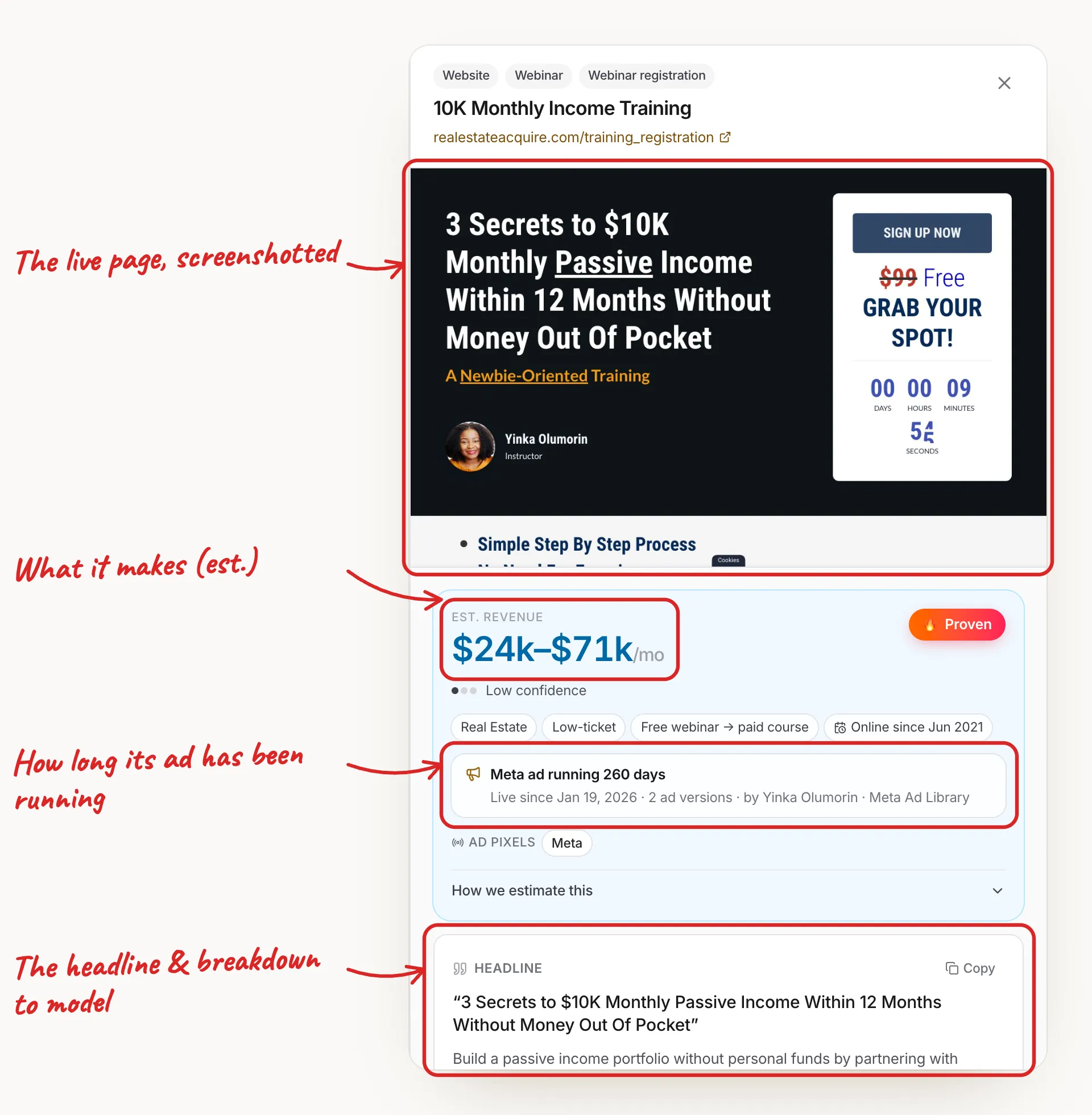
Tap the image to zoom in
Step 2 in detail: what to capture at each step
Walk the funnel like a buyer. Use a separate email address, so their follow-up is easy to study. At every step, write down:
| Step | What to write down |
|---|---|
| The ad | The first line (the hook), video or image, the button, the start date, how many versions run. |
| The landing page | Headline, the promise, the “how” behind it, what you get for opting in, how many form fields. |
| The order form | The price, payment plans, the order bump (the checkbox add-on) and the guarantee. |
| Upsells and downsells | Each offer, its price, and what happens when you say no. |
| The thank-you page | The next step they push: book a call, join a group, watch a video. |
| The follow-up | The first emails: subject lines, how often, what they sell. |
Step 3 in detail: the breakdown sheet
One row per element. The last column is the whole game — keep the structure, replace everything that’s theirs:
| Element | Keep | Replace with yours |
|---|---|---|
| Hook What stops the scroll? | The angle | The words |
| Promise What result, how fast? | The kind of result | Only what you can deliver |
| Mechanism Why will it work this time? | Having a named method | Your own method |
| Offer What exactly do they get? | Product + bonuses + guarantee | Your product, your bonuses |
| Price Front end, bump, upsells? | The shape of the ladder | Prices that fit your costs |
| Proof Why believe it? | Where proof sits on the page | Your own real proof |
| Call to action What’s the next step? | The next step | The words on the button |
Step 4 in detail: find the pattern
Fill in the sheet for 5 to 10 proven funnels in your niche, side by side. Then count. If most of them run a webinar, a webinar is your market’s default. If most front-end prices sit in the same range, that’s what your buyers expect to pay. One funnel is an example. A pattern is a decision.
Claims you must never copy
Income and results claims are where modeling turns into risk. In October 2021 the FTC sent notices to more than 1,100 companies — business-opportunity and investment-coaching firms among them — warning against deceptive money-making claims, and to more than 700 about fake reviews and misleading endorsements.
- Someone else’s earnings or results claims.
- Someone else’s testimonials — or invented ones.
Is funnel hacking a scam?
No — it’s research. Every good marketer studies what works before building. The scams sell the dream (“copy this funnel, make millions”). The method is plain: find proven funnels, understand why they work, build your own.
Questions
What is funnel hacking?
Studying competitors’ funnels — their structure, offer and steps — and using what you learn to build your own, without copying their words, images or brand.
Is funnel hacking legal?
Modeling structure and ideas is generally fine — copyright doesn’t protect ideas or methods. Copying words, images, testimonials or brand names is not. This isn’t legal advice.
How many funnels should I study?
Five to ten proven funnels in your niche. One is an example; what repeats across many is a pattern worth building on.
Do I need ClickFunnels to funnel hack?
No. Funnel hacking is a research method — it works with any page builder, or none. You only need a way to find funnels that are working and a place to write down what you see.
Should I opt in to a competitor’s funnel?
Yes — it’s the only way to see the thank-you page and the follow-up emails. Use a separate email address so everything they send is in one place.
Sources
- ClickFunnels — Marketing funnel hacking (updated March 2026)
- U.S. Copyright Office — Copyright FAQ
- FTC — Notice to over 1,100 businesses about deceptive money-making claims (Oct 2021)
- FTC — Notice to hundreds of businesses about fake reviews and misleading endorsements (Oct 2021)
Checked on October 15, 2026. Platforms change their tools — if something looks different, the official pages above have the latest.
Keep reading
Find the funnels worth modeling in your niche
Proven funnels, broken down — so you model what works, not what looks good.