Finding funnels · 2 min read
How to Find and Analyze Your Competitors’ Sales Funnels
Your competitors’ best funnels don’t show up on Google. They live behind their ads. Here’s how to find them, walk every step, and decide which ones are worth modeling.
Start from the ads, not from Google
Funnels built for paid traffic usually have no menu, aren’t linked from the homepage and often sit on their own subdomain. Search engines rarely show them. The reliable way in is the same door the buyers use: the ads.
Find their live ads and landing pages
- Meta: search the competitor’s Page or a phrase they use in the Meta Ad Library, open See ad details and follow the link.
- Google: the Ads Transparency Center shows their ads, but you can’t click through to landing pages — use the domain it lists and the ad text to find the page.
- The site itself: check it for ad pixels — here’s how.
Walk the whole funnel
Go through it like a buyer and screenshot every step. A typical paid funnel looks like this:
ClickFunnels’ own funnel-hacking guide recommends exactly this — “Document Everything with Screenshots” — and even buying competitors’ products to see the full back end.
What to record at each step
| Step | Write down |
|---|---|
| Ad | The hook, the format (video, image), how long it’s run, how many versions |
| Landing page | Headline, promise, proof, the call to action, the funnel type (VSL, webinar, quiz, sales page) |
| Order form | Price, payment options, guarantee, the order bump |
| Upsells | What’s offered next and at what price |
| Thank-you page | The next step they push: a call, a group, another offer |
Is it worth modeling? Check the proof
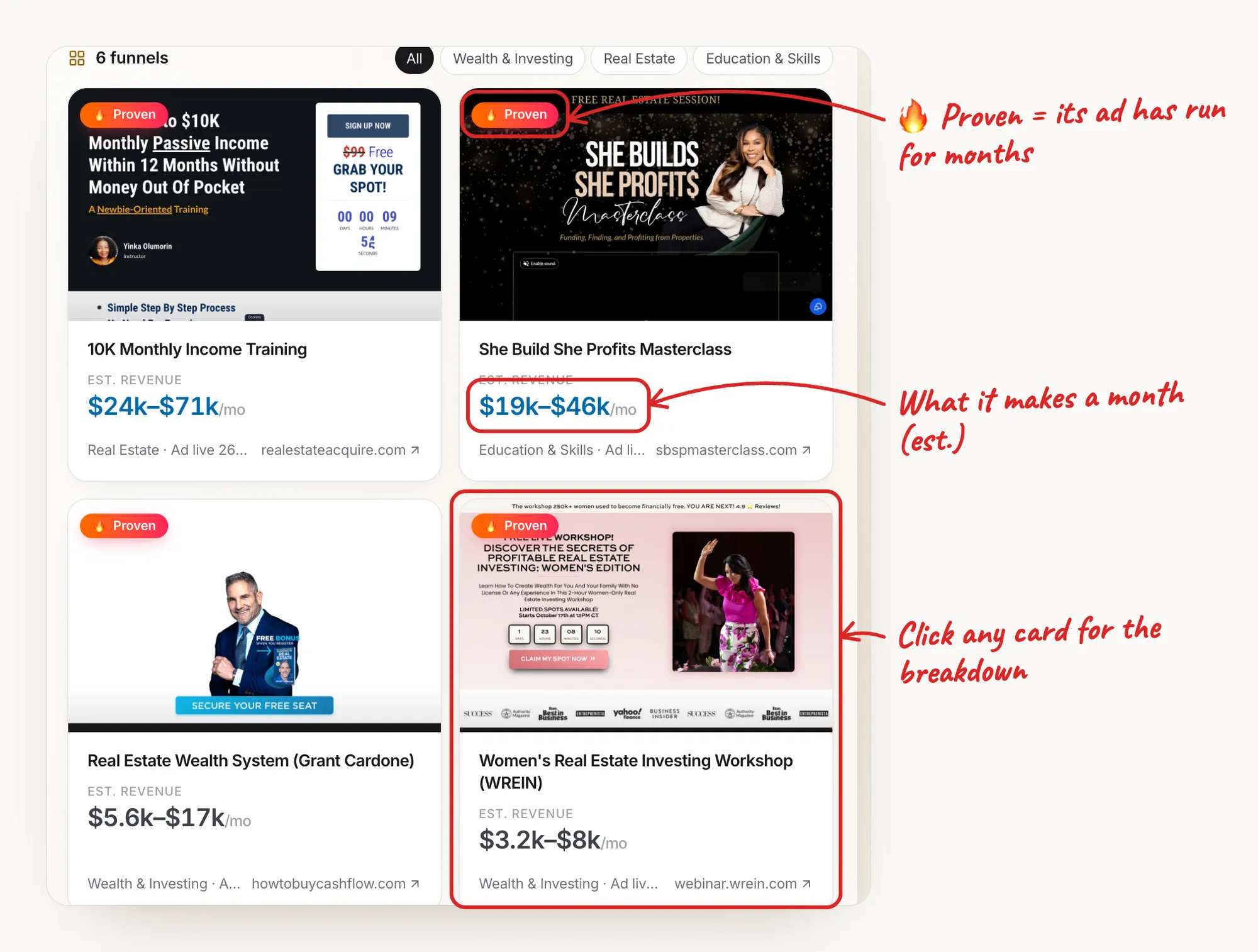
- The ad has run for months — and still runs.
- The page has ad pixels — it tracks paid traffic.
- There’s a real price and a real checkout.
- The domain isn’t brand new — ICANN’s registration lookup shows its age.
More on each in How to Tell If a Competitor’s Facebook Ad Is Profitable.
Where funnels hide
- Subdomains: go.brand.com, join.brand.com, offer.brand.com.
- Funnel-builder domains: pages on ClickFunnels, Kajabi, Systeme.io or similar often live on the builder’s own domain.
- Long paths: brand.com/webinar-registration-v3 — never linked from the menu.
Turn 5–10 teardowns into a pattern
One funnel is an example. The same move in five proven funnels is a rule. Line your teardowns up and look for what repeats — the funnel type, the price points, the kind of hook. Then build yours on that — see Funnel Hacking: How to Model a Funnel Without Copying It.
Do it for a whole niche at once
Doing this by hand takes hours per competitor. Winning Funnels finds the funnels running ads in your niche, screenshots each one and shows the proof — run time, pixels and an estimate of what it makes:
Tap the image to zoom in
Questions
How do I find my competitors’ landing pages?
Start from their ads: the Meta Ad Library’s “See ad details” links to the landing page. Google’s Transparency Center shows their ads and domain but doesn’t let you click through.
What is competitor funnel analysis?
Walking a competitor’s funnel step by step — ad, landing page, order form, upsells, thank-you page — and recording the offer, price and proof at each step.
Should I buy my competitor’s product?
If the price is reasonable, yes — it’s the only way to see the upsells and follow-up. ClickFunnels’ own funnel-hacking guide recommends it.
Sources
- ClickFunnels — Marketing funnel hacking (updated March 2026)
- Meta Business Help Center — About the Meta Ad Library (what each region shows)
- Google Ads Transparency Center — FAQ
- ICANN — Registration Data Access Protocol (RDAP)
Checked on October 15, 2026. Platforms change their tools — if something looks different, the official pages above have the latest.
Keep reading
Find every competitor funnel in your niche
Type your niche — the AI finds the funnels running ads and shows you the proof.