Finding funnels · 3 min read
How to audit a competitor's funnel in 30 minutes
A client asks, "What are the others doing?" This checklist lets you answer in half an hour, with screenshots and a one-page summary instead of opinions.
Why do this before building anything
Most funnel work starts from a blank page. That is slow and risky.
A competitor funnel that has been running ads for weeks already survived real traffic. You can learn its structure for free. You cannot learn its results, so treat everything below as a clue, not proof.
Why it matters: A client sees a one-page audit and understands your plan in two minutes. That makes the project easier to approve and easier to keep.
Step 1: Pick 3 competitors (5 minutes)
Use the Meta Ad Library and search the client’s niche with the words their buyer uses.
Pick three advertisers with active ads that started 30 or more days ago. Why those? Advertisers tend to stop ads that lose money. See how to tell which competitor ads make money.
Write down each advertiser’s name, ad count and oldest start date.
Step 2: Save the ads (5 minutes)
For each advertiser, screenshot the 2 or 3 oldest active ads.
Note three things per ad:
- The promise (what the buyer gets)
- The hook (the first line or image)
- The call to action (button text)
Step 3: Walk the funnel as a buyer (10 minutes)
Click the oldest ad. Then go step by step, and screenshot every page:
- The landing page
- Any quiz, video or form before the offer
- The offer page
- The checkout or booking page
- The page after purchase (upsell, thank-you)
Use a private window. Use a throwaway email. Do not buy unless the client asks for it.
If you want a deeper method, see how to analyze competitor sales funnels.
Step 4: Fill in the audit table (5 minutes)
Score each competitor on the same rows:
| Row | Competitor A | Competitor B | Competitor C |
|---|---|---|---|
| Main promise | |||
| Funnel type (VSL, quiz, webinar, call booking) | |||
| Number of steps | |||
| Proof used (reviews, numbers, case study) | |||
| Offer and price shown | |||
| Upsell or follow-up | |||
| Oldest active ad |
Keep every cell short. If you cannot see something, write “not visible”. Never guess a number.
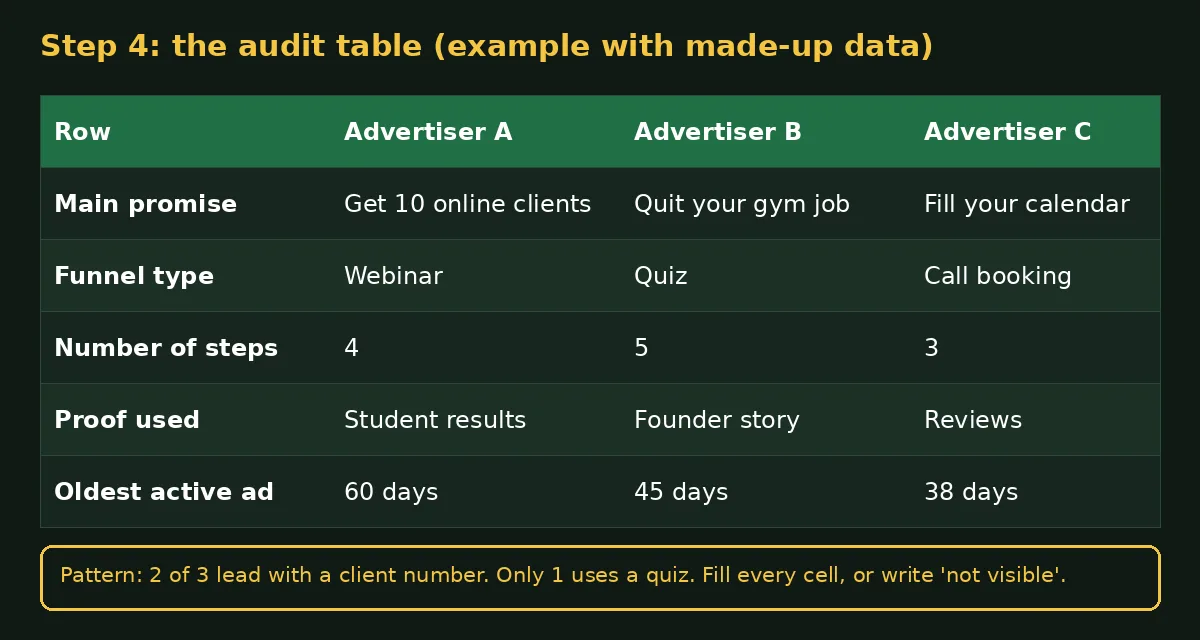
Worked example (made-up data, for illustration)
Say your client sells an online course for personal trainers. You pick three advertisers from the Ad Library and fill the table.
| Row | Advertiser A | Advertiser B | Advertiser C |
|---|---|---|---|
| Main promise | Get 10 online clients | Quit your gym job | Fill your calendar |
| Funnel type | Webinar | Quiz | Call booking |
| Number of steps | 4 | 5 | 3 |
| Proof used | Student results | Founder story | Reviews |
| Oldest active ad | 60 days | 45 days | 38 days |
Now look for the pattern. Two of the three lead with a specific client number. Only one uses a quiz. None shows a price before the booking or checkout step.
The one-pager could then say: “Our first test is a headline with a specific client number. We will also test a short quiz, because only one competitor uses it.”
That is a plan the client can approve. It is built on what you saw, and it claims nothing about their sales.
Step 5: Write the one-pager (5 minutes)
Answer four questions in plain words:
- What do all three have in common?
- What does only one of them do?
- What is missing that the client could do better?
- What will we test first?
Attach the screenshots. Send it before the kickoff call.
Common mistakes
- Copying words. Copy the structure, never the text, images or claims.
- Reading one funnel. One funnel is an anecdote. Three show a pattern.
- Treating ad age as profit. Ad age is a clue. It does not show sales.
- Skipping the mobile view. Most ad clicks happen on phones, so open each page on one.
Where Find Winning Funnels fits
Doing this by hand works. It gets slow when you repeat it for every client and niche.
Find Winning Funnels is an AI agent that finds funnels running paid ads in a niche and gives an estimate of what they make. Treat the estimate as a clue too.
Start free or book 15 minutes if you want help setting up this audit for your clients.
Tap the image to zoom in
Questions
Can I see how much a competitor's funnel earns?
No. Public tools do not show a competitor’s sales. You can only read signs such as ad age, funnel structure and page quality.
Is it okay to walk through a competitor's funnel?
Viewing public pages as a visitor is normal market research. Do not submit false payment details or copy their text and images.
How many competitors should I audit?
Three is enough to see a pattern. Ten is enough for a niche report.
What should I do if a competitor's funnel has a login or a paywall?
Audit what a visitor can see and write “not visible” for the rest. Do not try to get past a login you have no right to use.
Do I need paid tools?
No. The Meta Ad Library is free and public, and a spreadsheet is enough for the table.
Sources
- Meta Ad Library
- How to use the Meta Ad Library
- How to analyze competitor sales funnels
- How to tell which competitor ads make money
Checked on October 23, 2026. Platforms change their tools — if something looks different, the official pages above have the latest.
Keep reading
Find the funnels making money in your niche
Type it below. It’s free.