Ads & competitors · 3 min read
How to Tell If a Competitor’s Facebook Ad Is Profitable
You can’t see their spend or their sales. But a winning ad leaves clues anyone can read. Here are seven — and what each one can’t tell you.
What you can’t see
For regular commercial ads, the Meta Ad Library shows the ad and the date it started running. No spend, no impressions, no reach, no results. Nobody outside the advertiser’s account sees their ROAS. So every answer here is a judgement from public signals — and the more signals agree, the safer it is.
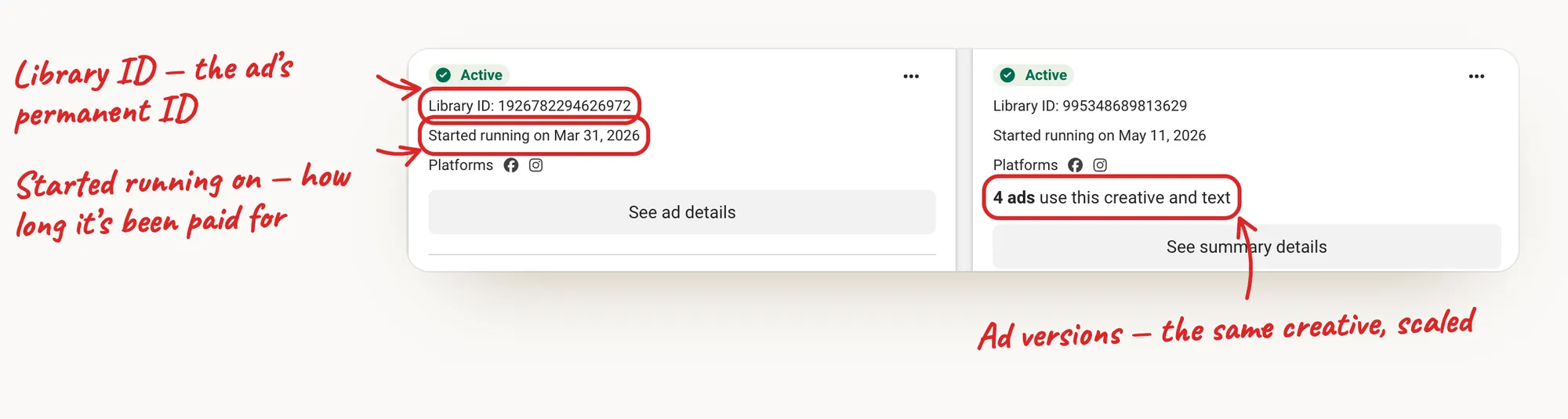
Signal 1: how long it’s been running
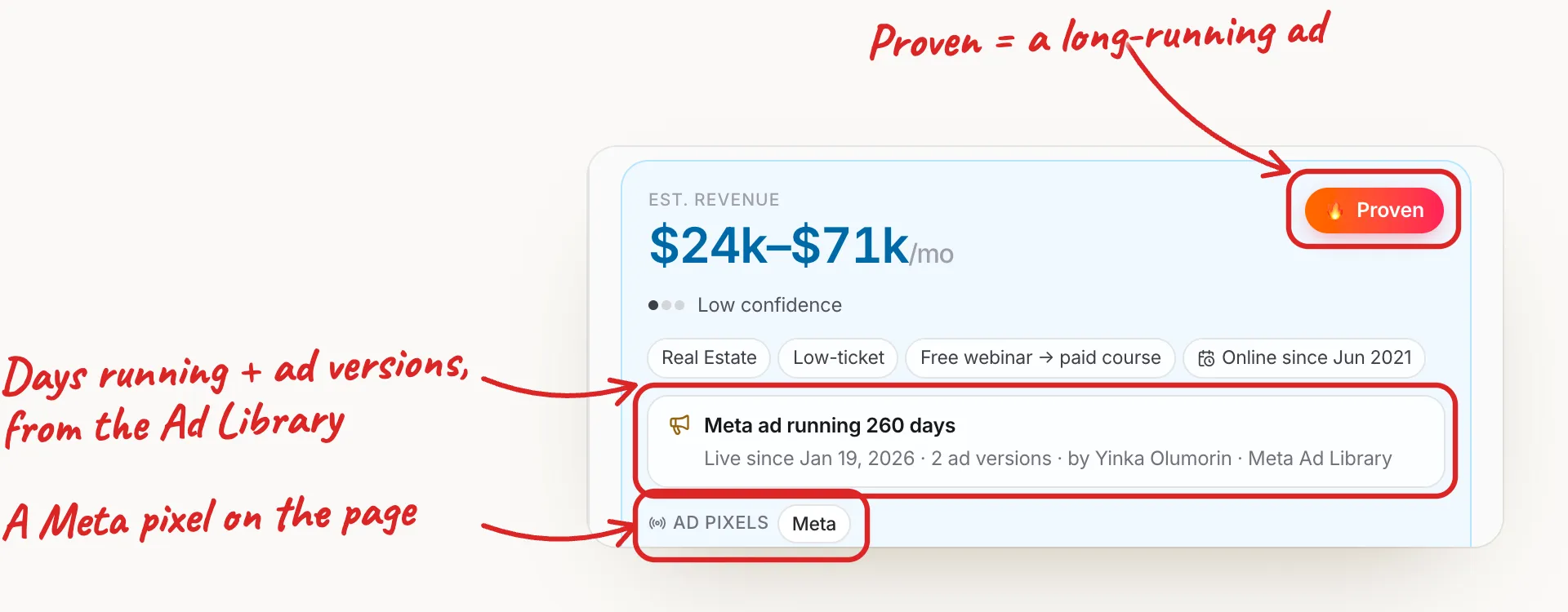
Regular ads disappear from the Library when they stop. An ad that started months ago and is still active is one the advertiser keeps paying for, day after day.
There’s no official day count that means “profitable”. Treat months as a strong sign, not proof.
Signal 2: how many versions run
Cards that say “N ads use this creative and text” are the same ad running several times. Advertisers duplicate what works into new audiences and placements.
Tap the image to zoom in
Signal 3: reach, if it runs in the EU or UK
For ads delivered in the EU or UK, Meta shows total reach and its breakdown by age, gender and location. If your competitor advertises there too, switch the Library’s country and you get a real size number.
Signal 4: the landing page has an ad pixel
A Meta, Google or TikTok pixel on the landing page means the advertiser measures what that traffic does — the setup of someone optimizing ads for sales. How to check it: How to Check If a Website Is Running Paid Ads.
Signal 5: there’s a real offer behind it
Click through. Is there a price, an order form, a booking calendar? An ad that leads to a real checkout is selling something. An ad that leads to a homepage or a blog post is usually building awareness.
Signal 6: they keep launching new ads to the same page
Search the advertiser’s Page. If new ads keep appearing — new hooks, new videos — all pointing at the same funnel, that funnel is the one paying the bills.
Signal 7: Page and domain age
The Ad Library shows when a Page was created and its name changes. For the website, ICANN’s registration lookup (RDAP) shows when the domain was registered. A business buying ads for years is usually a business that makes them pay.
False positives: when a long-running ad still loses money
- Brand budgets. Big brands run awareness ads that don’t need to sell directly.
- The back end pays for it. The front offer loses money on purpose; upsells or a high-ticket call make it back. (Still worth modeling — just model the whole funnel.)
- Forgotten ads. Small budgets can keep running for a while because nobody turned them off.
A 2-minute scorecard
| Signal | Strong sign | Weak sign |
|---|---|---|
| Run time | Started months ago, still active | Started this week |
| Versions | Several ads use the same creative | One ad, one version |
| Landing page | Ad pixel + a price or checkout | No pixel, no offer |
| Advertiser | New ads keep pointing to the same funnel | One-off ad |
| Age | Page and domain several years old | Both brand new |
Four or five strong signs? That funnel is worth studying. Winning Funnels shows them on every funnel it finds:
Tap the image to zoom in
Questions
Can you see a competitor’s Facebook ad spend?
Not for regular commercial ads — the Ad Library shows only the start date. Spend appears only for social issue, election and political ads.
How long does an ad need to run to be profitable?
There’s no official number. A few days proves nothing (ads are still in the learning phase); months of continuous running is a strong sign — not proof.
What does “N ads use this creative and text” mean?
The same ad is running as several versions — usually duplicated into more audiences or placements. Advertisers multiply what works.
Sources
- Meta Business Help Center — About the Meta Ad Library (what each region shows)
- Meta Business Help Center — About the learning phase
- ICANN — Registration Data Access Protocol (RDAP)
Checked on October 15, 2026. Platforms change their tools — if something looks different, the official pages above have the latest.
Keep reading
See the signals on every funnel in your niche
Run time, ad versions, pixels and a revenue estimate — found and checked for you.