Ads & competitors · 3 min read
How to find an offer angle that's already proven
Most people test a new angle with their own money. You can read the market first. These five steps show which angles competitors keep running, and why.
What an “angle” is
An angle is the reason someone should buy now. It is not the product. It is the promise, the person it is for and the proof.
Two coaches can sell the same program with different angles:
- “Lose 10 kg before your wedding” (event, deadline).
- “Fitness for busy dads” (a person, a time limit).
The product is the same. The angle decides who stops scrolling.
Why it matters: A bad angle makes every ad cost more. Finding a good one by testing costs money. Finding it by reading costs an afternoon.
The idea: money leaves clues
Paid ads cost money every day. A company usually keeps paying for an ad only while the ad is worth it to them. That is a rule of thumb, not proof. An old ad can also be a forgotten ad.
So the clue is not one ad. The clue is a pattern: the same promise, in many ads, from several companies, for weeks.
Step 1: Open the Meta Ad Library
The Ad Library is Meta’s public search for ads. It is free and needs no account to browse.
- Go to facebook.com/ads/library.
- Pick your country.
- Choose “All ads”.
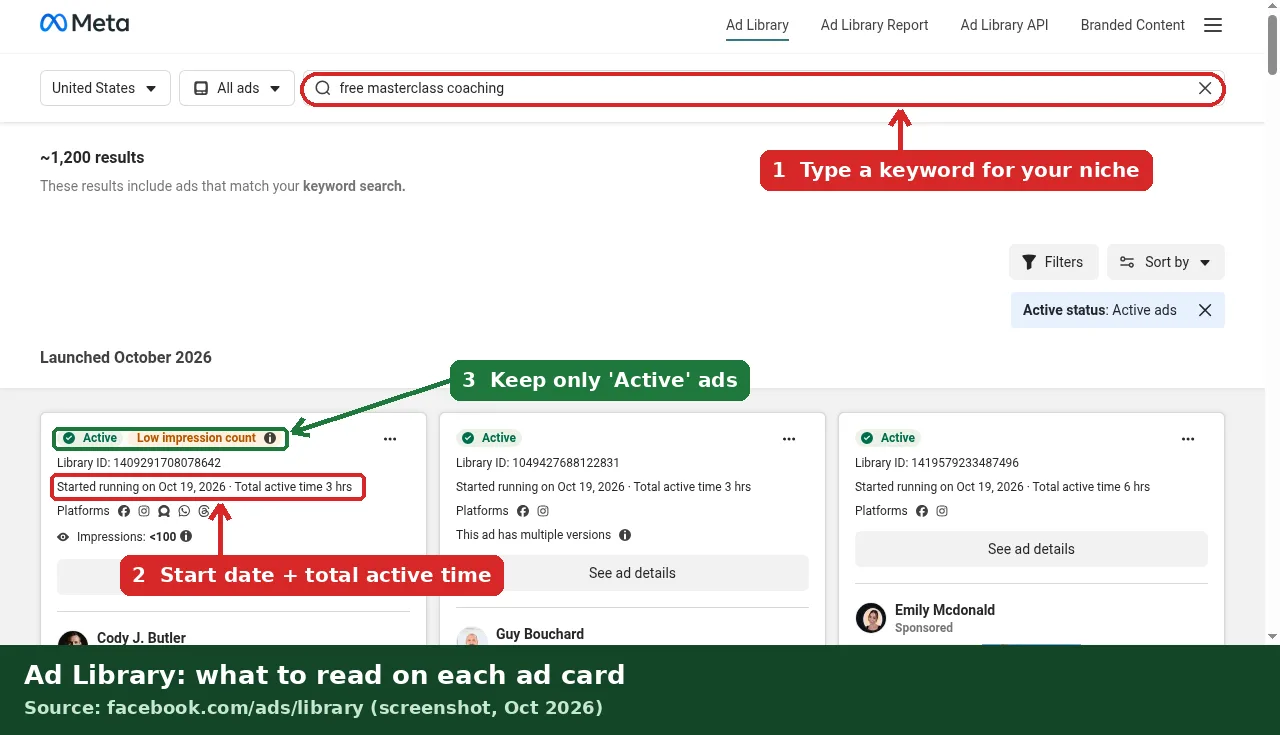
- Type a keyword your buyer would use, like “free masterclass coaching”.
Each ad card shows a status, a Library ID, a start date and the total active time. You will use those three.
Tap the image to zoom in
Step 2: Keep only active, older ads
Look at the start date on each card. Write down ads that are active and started weeks ago, not today.
A new ad tells you nothing yet. An ad that has been active for a long time tells you someone kept paying for it.
If you want more detail on reading the page, see how to use the Meta Ad Library.
Step 3: Write down the promise in each ad
Open 10 ads. For each one, copy five things into a sheet:
| Column | What to write |
|---|---|
| Company | Who runs it |
| Start date | From the card |
| Promise | The first line of the ad, in your words |
| Who it is for | The person named or implied |
| Proof | A number, a client, a before/after, or none |
Do not judge yet. Just write.
Step 4: Count the patterns
Now read your sheet. Count how many ads share the same promise or the same person.
- If 6 of 10 sell “get clients without cold calling”, that angle is crowded and clearly paid for.
- If 2 of 10 sell an angle nobody else uses, it is either a gap or a failure. Check how long those two have run.
You are looking for two things:
- An angle many companies keep running. That is proven demand.
- A version of it that few say, for example a narrower person or a clearer proof. That is your opening.
Step 5: Check the landing page
An ad is half the story. Click through and see what the person does next: a video, a quiz, a booking page, a webinar.
Write one line: “ad promise, then page promise, then ask.” If the page repeats the ad promise, the angle is consistent. This is the part you can copy as a structure, never as words.
For a full walk-through of this step, see how to analyze competitor sales funnels.
A worked example
Say you coach freelancers.
- You search “freelance clients course” and “get clients freelance”.
- You find 12 active ads, 8 of them older than a month.
- Five of the 8 promise “land your first client in 30 days”. Three name beginners. One names designers only, with a client logo as proof.
- The pattern: “first client in 30 days” is crowded. “Designers” has one advertiser and uses proof.
- Your test: a designer-focused version, with real proof you own.
No ad spend yet. You now have one specific angle to test, chosen from what the market already shows.
Where Find Winning Funnels fits
Doing this by hand works. It is slow when you repeat it for many niches.
Find Winning Funnels is an AI agent that does the search and the note-taking for you: it finds funnels running paid ads in a niche and shows what they promise. You still make the call on your angle.
Start free or book 15 minutes if you want help setting this up for your clients.
Questions
Does a long-running ad mean the ad is profitable?
No. It is a clue, not proof. Advertisers can leave ads running by mistake or for brand reasons. Look for patterns across several companies.
Is the Meta Ad Library free?
Yes. It is a public search at facebook.com/ads/library.
Can I copy a competitor's ad?
Copy the structure and the idea. Never copy the words, images or claims. Your proof must be your own.
How many ads should I read?
Ten to twenty per niche is enough to see patterns.
Sources
Checked on October 20, 2026. Platforms change their tools — if something looks different, the official pages above have the latest.
Keep reading
Find the funnels making money in your niche
Type it below. It’s free.